A Testimony 1928 – 2019

Never
Forget.

The Holocaust testimony of Nina Muller (née Guttman) — recorded in Tel Aviv in October 1999, after fifty years of silence. Now available to read in English and Hebrew.

Book coming soon

Thank you — we'll let you know when the book is ready.

I · The Testimony

Watch her
testimony, or read it.

Recorded by the USC Shoah Foundation in her apartment in Tel Aviv, October 29, 1999. Interviewed by Efrat Komisar. In Hebrew.

II · Timeline

Timeline.

Ninety years — prewar Łódź, the ghetto, the camps, liberation, Israel, and the long life she built afterward.

A few waypoints from a ninety-one-year life. Scroll →

1928
Łódź, Poland
Born Nina Guttman, an only child, after her parents had been married sixteen years.
1940
Łódź Ghetto
The Guttmans move inside before the ghetto is sealed on May 1, 1940.
1941
Łódź Ghetto
Her father dies of starvation in the autumn.
1942
Łódź Ghetto
Her mother dies. Nina, thirteen, is adopted by Luba Chesnowitz after the Sperre.
1944
Auschwitz-Birkenau
Deported at sixteen in the final liquidation. Separated from Luba on the ramp.
1945
Halbstadt
Liberated by the Red Army at the labor camp in the Sudetenland.
1946
Kielce, Poland
The Kielce pogrom. Nina decides Poland is no longer home and leaves for good.
1948
Israel
Immigrates to the newly founded state after a year in Cyprus.
1962
Israel
Her husband is killed. She raises two sons alone.
1999
Tel Aviv
Breaks fifty years of silence and records her testimony with the USC Shoah Foundation.
2019
Israel
Dies at ninety-one.
Open the full timeline Every year, every place
III · Glossary

Terms & places.

A short reference for the Hebrew words, place names, camps, and organizations that appear in the testimony.

Łódź Ghetto
The second-largest ghetto in Nazi-occupied Europe. Sealed May 1, 1940, and liquidated in August 1944. Nina lived inside it for four and a half years.
The Sperre
The September 1942 selection that seized the children, elderly, and sick of the Łódź Ghetto and sent them to their deaths at Chełmno.
Chesnowitz, Luba
The woman who adopted Nina in the Łódź Ghetto after her parents died. She was murdered at Auschwitz; Nina survived in her memory.
Rumkowski, Chaim
The Judenälteste of the Łódź Ghetto. His strategy of "salvation through labor" made the ghetto the longest-lasting in occupied Europe.
Schneider Ressort
The Łódź Ghetto tailoring factory where Nina sewed German army uniforms. It was here she met the Levkovitch family.
Halbstadt
The labor camp in the Sudetenland, near the Czech border, where Nina was liberated by the Red Army in May 1945.
Kielce
Polish city where a pogrom against returning Jewish survivors in July 1946 drove Nina's decision to leave Poland for good.
Cyprus
The British detention camps where Jewish refugees on their way to Palestine were held. Nina called it the "Winter Camp."
Open the full glossary All terms & places
IV · About

Nina Muller.

1928 – 2019
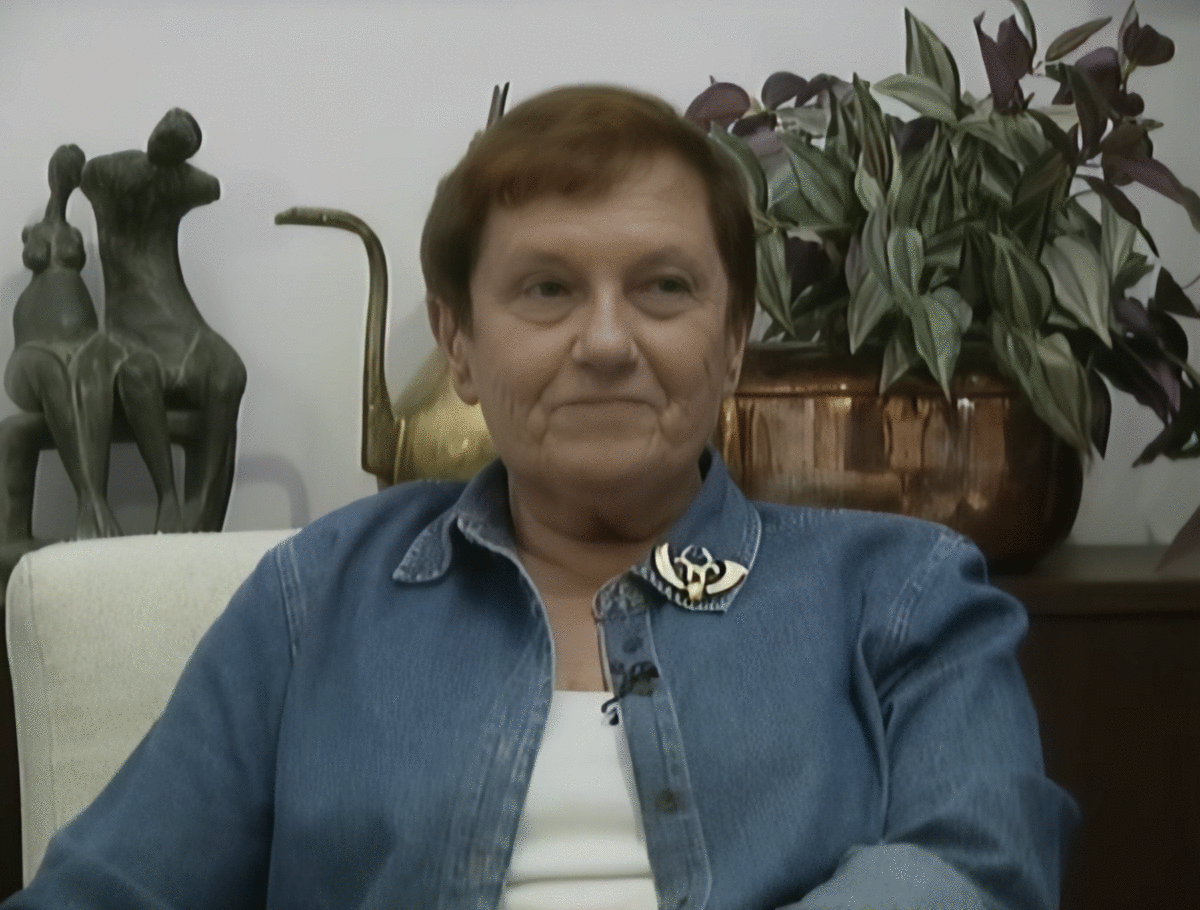
Nina Muller in her living room, Tel Aviv, 1999
Tel AvivOctober 1999

Nina Muller (née Guttman) was born on April 20, 1928, in Łódź, Poland. She survived the Łódź Ghetto, Auschwitz-Birkenau, and a series of labor camps before being liberated in 1945. She immigrated to Israel in 1948.

She trained as a nurse and rose to become head nurse at the hospital in Nahariya, a position she held until retiring in 1993. She studied sociology at the University of Haifa and raised two boys alone after her husband was killed in 1962. She was a mother of two sons, a grandmother of six, and were she still alive, a great-grandmother of six.

Nina was an amateur archaeologist, a woman with a close circle of loyal friends, and someone who loved learning and traveling throughout her life. She walked many kilometers through her beloved Tel Aviv well into her eighties.

For fifty years she kept silent about what she had endured. In 1999, after an encounter with Holocaust denial in the United States, she sat down with the USC Shoah Foundation in her apartment in Tel Aviv and, for the first time, spoke at length about what she had survived. She died in Israel in 2019.

This site and the accompanying book were prepared by her grandson, Gabriel Muller.

Dedication

I leave the past behind and move forward. I have very little time left in life to think, to look back — not with rage and not even with nostalgia — but just to move forward.

Nina Muller · 1928 – 2019